There is a certain satisfaction in prying open an oyster, a small victory of human ingenuity over nature's design. It is a ritual that precedes the pleasure of the taste, a moment of focused attention that connects us to the centuries of seafood lovers who came before. At the heart of this ritual lies a single, crucial tool: the oyster knife, or shucker. Its selection and, more importantly, its correct and safe use, are what separate a seamless, joyful experience from a frustrating, and potentially dangerous, ordeal. This is not merely about accessing a delicacy; it is about respecting the tool, the ingredient, and your own hands.
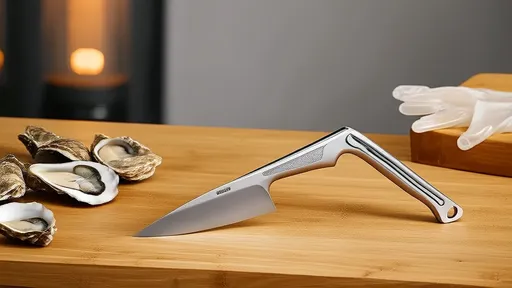
The world of oyster knives is deceptively complex, a quiet universe of specialized design where form is dictated entirely by function. A common mistake is to believe any sturdy, pointy blade will suffice. This misconception is the primary precursor to accidents. The oyster knife is a purpose-built instrument, engineered not for cutting, but for leveraging and twisting. Its blunt, thick blade is designed to withstand significant pressure without snapping, and its specific tip shapes are crafted to find purchase in the microscopic imperfections of an oyster's hinge. Using a paring knife, a screwdriver, or worse, a sharp blade, is an invitation for the tool to slip, potentially causing a serious laceration. The first and most fundamental rule of oyster shucking safety is to use the right tool for the job.
When selecting your blade, you will encounter a few key designs, each with its own philosophy. The most common is the Boston or New England style shucker. Characterized by a medium-length, sturdy blade that tapers to a sharpish point, it is a fantastic all-arounder. Its design is geared towards entering the oyster's hinge, the small, V-shaped area where the two shells are joined. The pointed tip is worked into this hinge to break the powerful adductor muscle's hold. This style offers good control and is a trusted favorite for both beginners and seasoned professionals working with East Coast varieties.
In contrast, the Province or French style knife presents a different approach. It typically features a shorter, wider, and more blunt blade, often with a slight curve. This design is less about piercing the hinge and more about sliding between the shells near the hinge and then leveraging them apart. It requires a different technique, one of finesse and a careful search for a natural gap rather than a forced entry. Many shuckers find this style offers superior control and reduces the risk of the knife slipping unexpectedly, as less stabbing force is applied.
For the briny, deeply-cupped, and often more stubborn oysters of the Pacific Northwest, the Pacific or Washington style knife reigns supreme. This tool is unmistakable: it boasts a long, strong, and relatively narrow blade with a sharp tip. The length is necessary to reach the adductor muscle nestled deep within the substantial shell of a Pacific oyster. Its design is robust, built to handle the significant torque required to pop these larger bivalves open. While highly effective for its intended purpose, its length and sharp point demand immense respect and a very steady hand.
Beyond these primary categories, you will find specialized variants. The Galveston style features a curved, almost claw-like blade designed for specific oyster types. Some knives come with a built-in guard between the blade and the handle to prevent your hand from sliding forward onto the blade during a slip—a valuable safety feature for novices. The handle material is also a critical consideration. It must provide a secure, non-slip grip even when wet and covered in briny oyster liquor. Wood, composite plastics, and textured rubber are all common and effective. A comfortable handle that fits well in your hand reduces fatigue and increases control, which is intrinsically safer.
Once the appropriate knife is in hand, the environment for the shucking itself must be prepared. Safety begins before the knife even touches the shell. Always shuck onto a stable, flat surface. A cutting board is ideal, but a folded kitchen towel placed on the counter will also work wonders. The towel does double duty: it prevents the oyster from skating around unpredictably, and it provides a cushion to absorb impact and vibration. Never, under any circumstances, attempt to hold the oyster in the palm of your bare hand. This infamous technique, often seen in movies, is a one-way ticket to the emergency room for a severe hand injury. The oyster's irregular, slick surface is incredibly unstable, and the immense pressure you apply can easily cause the knife to slip.
The proper way to secure the oyster is to fold a second, thick kitchen towel into a square and place the oyster inside, cupped side down, with the hinge pointing toward you. Wrap the towel around the oyster, gripping it firmly. This towel armor protects your hand from any potential slips and gives you a vastly superior grip on the stubborn shell. Your holding hand should be behind the knife's path at all times. Position your arms so your hands are working in front of your body, not over your lap or any other part of yourself. This contained workspace minimizes the distance the knife can travel if it does get away from you.
With the oyster secured in its towel armor and on a stable surface, you can now approach the hinge. Look for the small, tight crack where the two shells meet. For a Boston-style knife, the technique involves placing the tip of the blade into this hinge. Use firm, controlled pressure, wiggling or twisting the knife slightly rather than employing brute stabbing force. You are not trying to puncture the shell; you are trying to convince it to give up its seal. You will feel and often hear a distinct pop when the hinge breaks. This is the moment of success, but also a moment of heightened caution.
Once the seal is broken, the real finesse begins. Slide the blade carefully along the inside of the top, flat shell to sever the adductor muscle that is holding it shut. Keep the blade flat against the inside of the shell to avoid jabbing or cutting into the oyster's delicate body. After the muscle is severed, you can lift off the top shell. The oyster will still be attached to the bottom, cupped shell. Slide the blade underneath the oyster one more time, again keeping it flat against the shell, to gently cut it free. A good shucker leaves the oyster whole, swimming in its own liquor, and perfectly presented in its beautiful, natural bowl.
Throughout this entire process, your focus must be absolute. Do not shuck when distracted, tired, or under the influence of alcohol. It is a task that demands respect. If an oyster is particularly recalcitrant, do not fight it. Do not use excessive force. If your knife will not go in, try a different angle or a different spot on the hinge. If it still refuses, set it aside and try another oyster. Sometimes, you simply get a bad one—a "boxer" oyster that refuses to open. It is not a challenge to be won with violence. Forcing it will only result in a broken knife, a mangled oyster, or a injured hand. Wisdom, in shucking as in life, is knowing when to walk away.
Aftercare is part of the safe practice. A sharp knife is paradoxically safer than a dull one in many culinary contexts, but an oyster knife is a different story. Its blade should be strong and intact, but it does not need to be razor-sharp. Its power comes from leverage. However, a damaged blade with nicks or a bent tip can be unpredictable and should be repaired or replaced. Always wash and dry your knife immediately after use. Oyster liquor is corrosive and will pit and dull the metal over time. A well-maintained tool is a predictable tool, and predictability is the bedrock of safety.
Mastering the oyster knife is a rewarding skill, a blend of knowledge, the right equipment, and practiced, mindful technique. It transforms a potentially hazardous task into a graceful, almost meditative practice. It is about understanding that the goal is not just to open the shell, but to do so with respect for the creature inside, for the tool in your hand, and for the safety of your own body. The perfect oyster, pristine and waiting in its shell, is the delicious reward for this careful, considered approach.
By /Aug 20, 2025

By /Aug 20, 2025

By /Aug 20, 2025
By /Aug 20, 2025
By /Aug 20, 2025

By /Aug 20, 2025
By /Aug 20, 2025
By /Aug 20, 2025
By /Aug 20, 2025
By /Aug 20, 2025

By /Aug 20, 2025

By /Aug 20, 2025

By /Aug 20, 2025
By /Aug 20, 2025
By /Aug 20, 2025
By /Aug 20, 2025
By /Aug 20, 2025
By /Aug 20, 2025

By /Aug 20, 2025
By /Aug 20, 2025
